

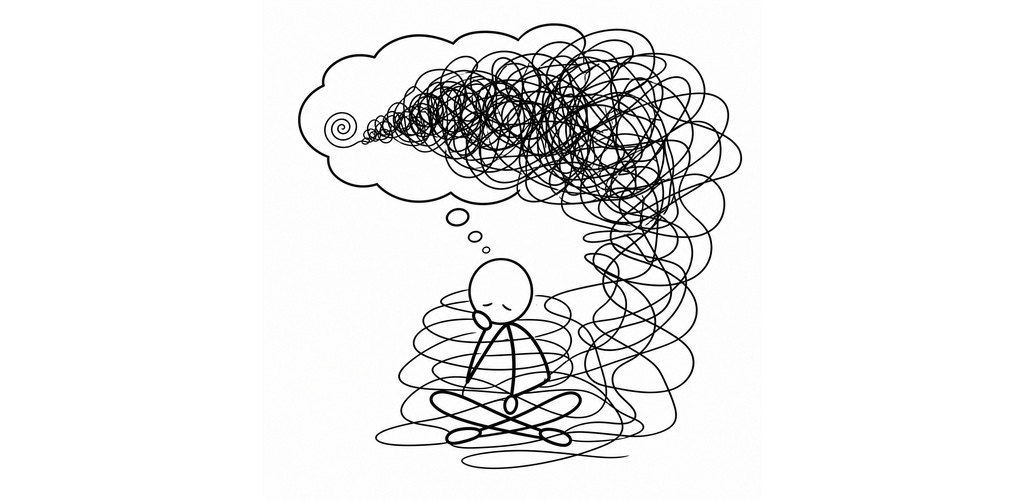
If you believe everything you think, you will stay stuck, spinning in spirals, unable to move forward.
You know the feeling.
You’re unhappy with where you are, but every time you try to change, try a new direction, you find yourself feeling heavy and stuck again.
No matter what you do, it feels like you’re driving with the emergency brake on.
So how do you find an exit to this stuckness?!
If this is you, that feeling has a name. It’s called misalignment. I know it because I lived it.
In this post, I’ll tell you why you’re still stuck:
it’s a habit most of us fall into without realizing it, one that feels productive but is actually the very thing blocking you from getting unstuck.
And I’ll show you how we can finally find a clearer, more aligned path.
The job I left, and the spiral that followed anyway
A few years ago, I left my high paying tech startup growth job because I felt what I now know as misalignment.

I was showing up, but forcefully. Overriding my curiosity to please others and force outcomes: a promotion, a pay increase, a great review. Nothing is wrong with wanting those things. But when we do things just for the outcome, when we only perform and don’t live, we betray ourselves.
We become misaligned.
And we drag this heavy, anxious feeling with us all the time, fueling the overthinking that keeps us spiraling and stuck.
Here’s the part that surprised me. When I left my job to find my “purpose,” I kept spiraling.
I launched a haircare venture, then a SaaS app. I tried consulting gigs, and even went back to a job.
The feeling followed me everywhere.
(If you’re curious what misalignment actually looks like, and whether you’re facing it too, check out my previous post on my personal story.)
Thinking your way out is the trap
You’re stuck because you’re trying to think your way out of being stuck.
That’s the trap. That’s the big reason you’re stuck.
Here’s why.
Think of your mind like software code. It’s what controls your default behavior, your tendencies, your “personality.”
That code was written as you grew from childhood into adulthood, coding your default reactions to things.
If you gave a presentation, hated it, and got laughed at, a line of code got written: avoid putting yourself in front of others.
If you felt bad, ate some sugar, and felt better, that got coded too: this is what you do when you feel low.
The more we repeat the same reactions to the same triggers, the more reinforced the code gets.
Now you’re an adult, and the code is so reinforced you can’t see beyond it. It just runs on autopilot.
So when you sit down to “think your way out” of being stuck, you’re not actually exploring anything new.
You’re just running the same code again, dressed up as reflection.
It feels productive, like you’re weighing options, exploring solutions, making progress.
But really, you’re just spiraling the same outcomes over and over.
Every time I was stuck, I did what overthinkers do: I paused to reflect on it.
And unknowingly, that’s exactly what threw me back into the spiral.
Every time I engaged my thinking mind to analyze what to do next, I got thrown off course again.
I thought I was making progress by analyzing, reflecting, thinking it through. I was actually keeping myself more stuck.
The mind is very good at throwing excuses to keep you from taking action into the uncertain…
…dressed up as smart, logical reasoning: procrastination, tempting alternatives that look like solutions but are actually just keeping you stuck, spiraling, repeating the same default reactions to the same triggers.
So what can you rely on, if not your mind?
So if you’re stuck, and you can’t trust what you think, how do you snap out of it?
How do you find clarity? A better path?
If you can’t listen to the mind, what can you listen to?
Let the water settle
Just as when you have dirty, muddied water and you’re trying to see clearly, shaking it up and forcing a path doesn’t help.
It helps to let it settle.
Give it time, give it peace, and clear water emerges on its own.
The same thing happens when we stop trying to force and think our way out.
When we unhook from thinking altogether and create space for the heavy emotions instead of fighting them, we make room for a much larger perspective.
We become aware of more in our environment, through all our senses.
We start noticing creative possibilities we couldn’t see before.
Early in my career, I came across a book called The Confidence Gap by Russ Harris.
I picked it up to seem more confident in interviews and presentations. I had a real fear of putting myself out there.
The premise: if you’re feeling a heavy emotion like fear or nervousness, there’s a technique called NAME.
I won’t go into the details here, but it uses your breath to create space around the emotion, so you can let the emotion stay while you move on anyway.
As you create that space, the emotion is no longer your whole world. It becomes a small part of your perspective. It stops overtaking your decisions.
It’s an incredible technique.
It’s helped me ace interviews and presentations like nothing else has.
But I realized I needed to apply the same technique to the feeling of misalignment, every single time it showed up.
Russ Harris gives a beautiful example in the book.
What happens when you mix a cup of salt into a cup of water? How does that taste? Salty and unpalatable.
Now take that same cup of salt and mix it into a flowing river. Taste the river.
Can you still taste the salt?
The salt, as he puts it, is the inevitable pain of life.
It doesn’t need to control us. We don’t need to fight it or interrogate it. When we do, we actually feed it.
That’s what happens when we create space instead of forcing our way out.
We’re no longer just the cup. We have the whole river, the whole ocean, to explore.
The secret to getting unstuck
That is the secret. Not to fight the misalignment, not to fight the stuckness, and certainly not to analyze it to death.
Instead, unhook from the unhelpful thoughts.
Accept and create space for the heavy emotions, so you can expand your perspective.
This is how you let the muddied water settle.
This is how you see clearly amidst your tendencies, your baggage.
Your baggage still exists.
But it’s just a small percentage of your living experience.
Now you can live on, find a creative path to your biggest goals, and walk a path of alignment: joyfully, at ease, and vibrantly.
The compass we all have
Today we saw that when we create space from misalignment, from our thinking, and expand our perspective, we can finally see clearly.
This is how we open ourselves up to creative possibilities.
So the next question becomes: once we create space, what do we do next? How do we find our path of alignment?
How do we choose which direction to take action in?
There’s a compass within all of us that we can tap into, and once you start tapping into it, it gives a surprisingly clear answer.
Next week, I’ll go deeper into this compass and how to use it to experiment and find alignment, ease, and joy in your life, while living toward your biggest goals.
If you struggle with overthinking and misalignment, this will be immensely helpful to you as it was for me. Don’t miss it next week :)
Thanks for reading this far, genuinely!
If you want more of this in your inbox, subscribe. I’d love to have you.
When you subscribe, you’ll get two free gifts:
The Empty Your Cup journal template. This has been my personal go-to for the last couple of years, and it’s genuinely changed how clear my mind feels.
A quick daily practice to unhook from repetitive thought spirals and make room for new possibilities.The Get Unstuck guide. A step-by-step roadmap for taking action on your goals and rewiring your mind to actually support you in reaching them.
This one’s especially useful if you’re stuck trying to take action on your big goals.
Subscribe for free below and they’re yours. See you next week!